The Tampa Bay Bucs football team are the latest to bring MRSA to the forefront. But what is the all the concern about? How contagious is it? Why is there concerns over the players locker room? What makes this such a concerning infection?
MRSA, an acronym for Methicillin Resistant Staphylococcus Aureus, that refers to a bacteria that is resistant to some antibiotics. Staph (short for Staplycoccus) Aureus is a common bacteria normally found on the skin. The bacteria becomes a problem when there is a break in the skin from an ingrown toenail, cut, or scrape that allows the bacteria to get in. The bacteria then can reproduce and cause an infection. Normally amoxicillin or cephalosporin could be used to treat this infection. However, in the case of MRSA, stronger more potent antibiotics need to be used for treatment. The concern is that fewer oral antibiotics can be used to eradicate this infection. As the incidence of MRSA increases, the potential for greater resistance to antibiotics increase leading to fewer and fewer antibiotics to fight off this infection. Now that is the worst case scenario. Through the judicious use of appropriate antibiotics and limiting exposure to MRSA, health care professionals are preventing drug resistance. Hospitals are routinely swabbing a patient's nose to identify MRSA that may already be colonized and present, but not causing infection. These patients are isolated from other patients who have tested negative just to prevent the spread of the bacteria.
MRSA can be spread from person to person or from object to person. However, the bacteria can last in the environment days to weeks. Common ways of spreading the bacteria would be from sharing razors, towels, or direct contact from an infected wound. In the case of the Tampa Bay Buccaneers the spread of MRSA is mostly likely from infected towels in their locker room.
There are ways of protecting yourself. Most alcohol or antibacterial soaps will kill the bacterial. Frequent hand washing can stop the spread of the organism. Also, keeping wounds covered will attempt to prevent infection. Avoid contact with a person who is being actively treated for MRSA.
MRSA is a concern but there are simply ways to protect yourself. Most importantly, if you have been prescribed antibiotics take them according to the doctor's prescription to avoid resistance.
Dr. Alexandra "Sandie" Grulke
http://www.podiatrycarespecialists.com/
Tuesday, October 15, 2013
Tuesday, September 10, 2013
Dez Bryant Midfoot Sprain - What is that?
Now I'm not a huge fan of Dez Bryant or the Cowboy's but his recent injury in the Giants game on Sunday brings up an interesting point. The injury occurred late in the fourth quarter of the win over New York when safety Ryan Mundy came down on Bryant's left leg while making a tackle. An MRI confirmed a midfoot sprain. What is a midfoot sprain? Midfoot sprain is a very generic term when there is pain across the mid portion of the foot. What does that mean?
Well, the midfoot encompasses quite a few muscles, tendon, joints and ligaments. So a midfoot strain can mean quite a few things. For example, the midfoot serves as the attachment of 4 major tendons from the leg, 10 joints, and 3 major ligaments. You can see why a midfoot sprain is a very ambiguous term. Let us get into some detail about the midfoot.
1. Tendons- The midfoot has 2 major tendons attaching into each side of the foot. On the inside of the foot there is the Posterior Tibial tendon and the Tibialis Anterior tendon. These are the major supports of the arch and are responsible for turning the foot in. The outside of the foot has 2 tendons, Peroneus Brevis and Longus, that attach in the midfoot. These tendons are responsible for turning the foot out. So it could be that Dez's midfoot sprain could be an irritation of theses tendons where they attach to the bone.
2. Joints-Included in the joints of the midfoot is the Lis Franc joint, however, this term includes 5 small joints. The Lis Franc joint connects the long bones behind the toes, metatarsal, to the midtarsal bones. In a Lis Franc injury the bones can fracture, dislocate, or even overstretch some of the ligaments between the bones. All joints have a soft tissue covering, capsule, surrounding them. These can be stretched or the joints become inflammed.
3. Ligaments- There are many small ligaments in the midfoot. However, there are three larger ligaments we are concerned with. The long plantar ligament is along the outside of the foot. The Spring ligament is on the inside of the foot and helps to support the arch. Studies have shown that a tear within this ligament can cause a painful flatfoot. Lastly, the Lis Franc ligament descibed above is included in the major ligaments in the midfoot.
So a midfoot sprain is a very ambiguous term. Most of the treatments for these injuries, however, would be similar. Rest, Ice, Compression and Elevation are the tenants of treatment. Dez will be sitting on the sideline for this week's practices but he could be ready to go against Andy Reid and the Chiefs.
By the way.... WHAT A WIN FOR THE EAGLES OVER THE SKINS LAST NIGHT!
E...A...G...L...E...S Eagles!
Dr. "Sandie" Grulke
http://www.podiatrycarespecialists.com/
Tuesday, August 6, 2013
SKECHERS Twinkle Talls Falls Short
If your girls are like mine they like all that sparkles and glitters. These new Skechers Twinkle Talls do all that and more. They boast a 2 inch hidden heel wedge to allow girls to look taller. Now I am not even going to get into the concerns of having our children look older than they are and look at this from a purely foot health standpoint. What can this 2 inch hidden heel wedge do for children?
The 2 inch heel wedge would lift the heel off the ground by 2 inches. Why is that a problem? Well the Achilles tendon, the strongest and largest tendon in the body, attaches to the back of the heel bone. If the heel is lifted off the ground 2 inches the Achilles tendon can shorten over time. This shortened tendon results in limited motion of the ankle especially moving the ankle up and can lead to other foot, leg, or back problems. The most common methods of compensation, for being able to move the ankle up, are flattening of the arch, picking up the heel early when walking, or placing increased pressure on the ball of the foot. Depending on how a child compensates for the inability to bend properly at the ankle, a variety of foot conditions can develop, including:
1-Plantar fasciitis/Heel pain
2-Sever's disease
3-Calf cramping
4-Tendonitis
5-Pain at the Ball of the foot
6-Flatfoot
7-Pressure sores on the ball of the foot or the arch
8-Bunions and hammertoes
9-Ankle pain
10-Shin splints
So as we begin the season of Back to School Shopping I recommend passing right on by these shoes and pick some sensible and equally glittery shoes.
Dr. Alexandra "Sandie" Grulke
http://www.podiatrycarespecialists.com/
Tuesday, July 2, 2013
Healthy Tip from Hand and Stone Massage on KYW Newsradio 1060
So yesterday in my car I was listening to KYW Newsradio 1060. Yes I did just sing that as I wrote it. I was happily surprised to hear a commercial from Stone and Hand Massage. They started their commercial by giving a healthy tip. This particular tip was the importance of keeping your feet in shape. They explained that without proper care, such as maintenance and stretching, your feet can develop sprains, strains and pain. They discussed what to do if a problem develops; such as limit activities, ice and elevate. Just when I thought they would sell their massages as an answer to peoples foot pain I was pleasantly surprised. Instead, they told people with foot pain that does not immediately respond to these treatments to seek a podiatrist. Wow. I have to say I was pretty excited and even did a little happy dance when I heard it. I may have even listened to KYW for the rest of the day. Hope your day gives you something to dance about.
Dr. Alexandra "Sandie" Grulke
http://www.podiatrycarespecialists.com/
Tuesday, June 25, 2013
Longevity for Lady Liberty
This weekend I took my family to see a New York Liberty game. In addition to be a very exciting game, I got to see my cousin Katie Smith play. It has been along time since I have seen her play. She has played professional basketball since graduating college 17 years ago. She has just celebrated her 39th birthday 2 weeks ago and has not lost a step. She was amazing. She has always been a very dedicated player with magnificent work ethic. I believe her attention to her training has allowed her to be able to maintain her high level of play over the years. So what are the concerns in an aging athlete? What can you do to prevent injury? Here are some tips.
First, the warm up. Warming up is stretching the muscles and ligaments. In an older athlete this may take longer and is essential to prevent injuries. Also, as we age our vascular system responds slower to exercise so we need a longer warm up period slowly increasing the exercises intensity.
Secondly we lose flexibility as we age. Loss of flexibility is a natural effect of aging that can be counteracted through a program of daily stretching. The repetitive movements involved in practicing any sport for a long period of time results in muscular imbalances that get progressively more extreme.
Next, it is much more important as we age to increase stregth training. As we age we lose muscle mass. Most of the muscle mass lost due to the aging process is classified as type II, or ‘fast twitch' muscle fibers. These type II fibers are faster to contract and therefore give us our strength and power. In contrast Type I, or ‘slow twitch' muscle fibers are slow to contract and contribute to muscular endurance. The loss of overall muscle mass and muscle strength causes joints to bear greater stress during exercise, rather that dissipating it to surrounding muscle tissue. This extra stress to the joints commonly leads to athletic injuries such as tendonitis, ligament sprains, musculo-tendinous strains, as well as arthritis.
Lastly, take more time to recover. Older athletes need to allow themselves more time to recover between their most demanding training sessions.
Changing the way you train can increase the longetivity of your activities.
GOOD LUCK #30! Go New York Liberty!
Dr. Alexandra "Sandie" Grulke
http://www.podiatrycarespecialists.com/
Tuesday, June 4, 2013
Sunblock On Your Feet?
It is time for summer and you are slathering on the sunblock. Don't forget to put sunblock on your feet. That sounds funny, but melanoma can be found on the skin on your feet. Unfortunately, the survival rates of foot melanoma is low because it can often go undetected. What you should you be on the look out for?
The common characteristics of melanoma are as simple as A B C D.
Asymmetry meaning the shape of the lesions is not symmetrical, for example if you folded the lesion in half the halves would not line up. Borders or the outline of the lesions is not smooth or circular but scalloped or ragged. The malignant lesion maybe several Colors or variegated. Benign lesions tend to have just one color throughout the entire lesion. The last common characteristic of melanomas is the Diameter or size of the lesion. A diameter of about 6mm or greater, the size of a pencil eraser, has a greater chance of becoming malignant.
The most common age to develop a melanoma is in your 50's. Foot melanoma can affect men and women equally. Fair skinned with blue eyes have a higher chance of developing melanoma over other skin and eye types. The most common areas of your feet to develop melanoma is on the soles of your feet, between toes or under toenails.
If you notice a mole, bump, or patch on the skin it is important to get it checked out right away.
With 40,000 new cases discovered every year, regular inspections of your feet can catch this deadly cancer early. As a preventative measure, apply sunscreen to your feet not just the tops, but also between the toes and on the bottom of your feet as well.
Here's to a happy and healthy sunmmer
Dr. Alexandra "Sandie" Grulke
http://www.podiatrycarespecialists.com/
Tuesday, April 23, 2013
Getting Your Feet Healthy For the Summer
Here comes the warmer weather, causing many to kick off our shoes and socks and opt for flip flops or sandals. Perhaps though you have been ignoring your feet for the last several months and now need to get them in shape for flip flop and sandal weather. Here are some tips to get these feet fit for summer.
If you have noticed some thickening or color changes to your nails over the winter, you may have the start of a toenail fungal infection. There are now topical anti-fungal medications that can be used as a base coat before using regular nail polish is applied, to help prevent and treat toenail fungus. Get it checked out by your local podiatrist.
With these simple tips you can whip your feet into shape for whatever the summer may bring.
Dr. "Sandie" Grulke
http://www.podiatrycarespecialists.com/
First, start with an at home pedicure. Soak your feet in a lukewarm water to soften the skin and nails. Remember, if you are diabetic, have someone else check the temperature of the water. Remove any dirt out from under your nails. Then cut your nails straight across to reduce the chance of creating ingrown toenails. Do not cut your cuticles. They help keep germs away from your skin and nails.
Next, examine the parts of your feet that experience the most friction (such as your heels, the sides of your feet and big toe) as they will feel the most callused. The easiest way to soften these rough patches is by first soaking your feet in warm water and exfoliating skin that is extra dry. After you towel your feet dry, use a pumice stone on the callused areas. If your feet are extra-callused, you may have to repeat this process for a few days to notice results. After you’re done, it is important to apply a lotion over the dry patches of your feet to allow your skin to re-absorb moisture. Watch out for over the counter corn/callus removers. These are medicated with salicylic acid which can eat away both good skin and callus which can cause open sores and ulcerations if used inappropriately. These should never be used on diabetics.
If you have noticed some thickening or color changes to your nails over the winter, you may have the start of a toenail fungal infection. There are now topical anti-fungal medications that can be used as a base coat before using regular nail polish is applied, to help prevent and treat toenail fungus. Get it checked out by your local podiatrist.
With these simple tips you can whip your feet into shape for whatever the summer may bring.
Dr. "Sandie" Grulke
http://www.podiatrycarespecialists.com/
Tuesday, April 16, 2013
Marathon bombing brings out the best in Americans
It is hard to understand how yesterday's tragedy could have happened. Yet despite the horrifying scenes, you hear the good stories of people helping people. On the radio and TV we are forced to relive the terrifying scenes but now more and more stories of herioc events are being told. One such story is of a podiatrist who the Doctors at Podiatry Care Specialists all know, and the student doctors of his that assist at the finish line, all jumping in to help the wounded.
Dr. Palamarchuk, a podiatrist from Temple University School of Podiatric Medicine, has taken students to the Boston marathon for 28 years. A tent is set up for the end of the race for those runners suffering from foot and ankle issues to be treated. Most of the runners would be treated for simple blisters and ankle sprains. Not this year. They were located half a block from the explosion site. Dr. Palamarchuk and his students ran to the victims aid. They were able to triage patients. Taking the lead from the medical doctors in the area, they were able to treat some of the victims and move them out of the area. He was quoted in an article for NBC 10 to say "Everyone treated. It's just quick, grab whatever you can. They reacted quickly and took the lead of the medical doctors. It was a good effort. I was proud of them."
What should have been a exciting day turned into a horrifying events but yet these stories of good continue to prove the strength of the American people. As Fred Rogers stated "When I was a boy and I would see scary things in the news, my mother would say to me. Look for the helpers. You will always find people who are helping."
http://www.podiatrycarespecialists.com/
Dr. Palamarchuk, a podiatrist from Temple University School of Podiatric Medicine, has taken students to the Boston marathon for 28 years. A tent is set up for the end of the race for those runners suffering from foot and ankle issues to be treated. Most of the runners would be treated for simple blisters and ankle sprains. Not this year. They were located half a block from the explosion site. Dr. Palamarchuk and his students ran to the victims aid. They were able to triage patients. Taking the lead from the medical doctors in the area, they were able to treat some of the victims and move them out of the area. He was quoted in an article for NBC 10 to say "Everyone treated. It's just quick, grab whatever you can. They reacted quickly and took the lead of the medical doctors. It was a good effort. I was proud of them."
![]() |
| Dr. Palamarchuk |
What should have been a exciting day turned into a horrifying events but yet these stories of good continue to prove the strength of the American people. As Fred Rogers stated "When I was a boy and I would see scary things in the news, my mother would say to me. Look for the helpers. You will always find people who are helping."
http://www.podiatrycarespecialists.com/
Sunday, April 14, 2013
Kobe Bryant Achilles Rupture
To get back into activity, it can take anywhere from 9 months to a year for a full recovery. Kobe has already said that he is looking forward to returning and playing once he is healed from this. He will undoubtedly get a lot of physical therapy during his postoperative course.
For more information please visit our website
http://www.podiatrycarespecialists.com/
Monday, April 1, 2013
Kevin Ware Louisville Basketball Leg Injury
By now everyone has heard of Kevin Ware, the unfortunate basketball player who landed while trying to block a shot and fractured his tibia. It is not the play that has made the news but the type of injury that he sustained that has gotten such attention. His injury has been likened to the injury sustained by Joe Theismann, a career ending injury for the quarterback of the Washington Redskins. Both players sustained not only a fractured tibia but an open fracture which means the fractured bones have penetrated the skin and are exposed. How could this happen? What does this mean for Kevin Ware's future?
This injury was caused by the amount of weight placed on his tibia, the weight bearing bone of the lower leg, and then angle in which he was landing. The tibia snapped like a pencil causing the fracture to pierce through the skin. What can make these such concerning injuries are a number of things. First has the blood supply been disrupted at the level of the fracture? Second, has there been nerve damage? Has the skin been compromised, will the skin be too damaged to repair and need skin grafts to heal over the bone? Lastly, with the bone exposed there is a concern of developing an infection. For all these reasons an open fracture is considered a surgical emergency. The blood supply and nerves must be evaluated and repaired if necessary. Antibiotics must be immediately started. The bone must be stabilized. The time to treatment is extremely important in these cases. "The Golden Hour" is the period of time after an injury is sustained that prompt medical treatment will result in the best outcomes from the injury.
| Example of rod used in repair |
Dr. Alexandra 'Sandie" Grulke
http://www.podiatrycarespecialists.com/
Tuesday, March 12, 2013
Doggie EHR
Ironically over the weekend, my lovable happy idiotic yellow lab hurt his foot. I looked at his paw but I could not see any obvious reasons for his foot pain. He began limping on Saturday night but by yesterday morning he wasn't putting any weight on it at all, so I called the vet. When we entered out vet's office, which thankfully we haven't done for over 6 months, I noticed some rather big changes. First, they took a picture of him. Immediately they uploaded his picture into a computer. They took notes of his complaints, symptoms, history of injury and weight and typed into their laptop as part of his digital chart. After his examination, she typed her finding into his chart and then took some digital x-rays. We examined these together, luckily no breaks, but then the images were uploaded into his chart. At the end of our visit, he was diagnosed with a simple sprain and I was given electronic instructions in which I was told to rest his paw and avoid stairs and running. We were checking out they asked me for my email so that they could connect his chart to a "puppy portal". This would allow us to have access to his medical record via the Internet. This is exactly the direction health care is migrating towards.
Currently the government is encouraging doctor's office to move to a digital patient record, or Electronic Health Record (EHR). The goal of moving this way is to better track patients progress, track data over time, monitor preventative screenings, and its use as an important tool in patient safety and quality of care. Research has actually proved there are tremendous benefits of documentation, viewing, test ordering, prescribing etc. in regards to patient care and safety. So why doesn't every doctor's office have these systems yet? EHR systems, by itself, is a huge financial burden with an average cost of $24,000 per physician of up-front cost. These costs will continue to spiral with the addition of hardware, computer stations and servers , IT support, back up systems, and security. Also, there is a large amount of EHR vendors, each one with their own terminology. With these large variances of systems, data exchange between EHR providers/health institutions can be difficult. Often, lab values or x-rays need to be manually added to the digital record because of an incompatibility between the one facilities EHR and the physician's EHR. Eventually, patients and medical professionals who are authorized to do so, will be able to assess these records via the Internet. These records will be stored in a secure storage on the Internet called a Patient Portal, such as Microsoft Health Vault TM. This allows doctors and hospitals to access this information urgently, especially in cases where the patient is unable to communicate pertinent medical history, allergies or current medications.
There are many obstacles before we are able to get everyone on board and all systems able to comminucate. However, as you can see the benefits are great. At Podiatry Care Specialists, PC, we have been using EHR since October 2010. For the most part, it has been a seemless transition and as our practice grows and we open new office locations, it has enabled us to quickly and efficiently access our patient's records no matter which office they are being seen.
By the way, my dog is not following his printed instructions.
Dr. Alexandra 'Sandie" Grulke
http://www.podiatrycarespecialists.com/
Tuesday, January 8, 2013
Don't Let Foot Pain Sidetrack your New Year's Resolutions
How often do you hear resolutions that sound like this; "I want to be healthier, I want to lose weight, I want to start exercising more, I want to start taking better care of myself." All of those are great but it can be difficult to keep these resolutions. Many of these resolutions include starting an exercise regiment. It is important to follow these simple tips to prevent injuring yourself and keep on track with your New Year's goals. Common foot problems such as plantar fasciitis or heel pain can occur after starting an exercise program. Here are some tips to prevent heel pain.
Proper stretching before and after the activity planned is essential to prevent heel pain or strains/ sprains. Stretches should include stretching of the achilles, hamstrings and lower back stretches.
Wearing good supportive shoes that are designed for the sport or activity you are performing. For example, a hiking shoe is not appropriate for running. Each sport has specific designs incorporated into the shoe based on the support the feet need during the particular activity. Aerobic shoes have greater side support to account for the repetitive side to side motion. Running shoes need to be light weight and cushioned to help absorb the forces of running on the feet and legs. Running shoes have become very sophisticated and can help even correct some foot problems. The shoes can help limit pronation (a flattening of the arch), or supination (a higher arched foot), or maintain a neutral position. It is important to get the appropriate correction in your shoes or you may injury yourself. Understand that the arch height is determined when you stand on your foot. Quite often patients tell me that they have a high arch but once they stand up it is obvious they have an arch that is collapsing. Have a trained professional evaluate your arch before spending money on shoes that may not be appropriate.
If you have pain that last more than 5 days and is not responding to rest or ice, you should call your podiatrist. Your goals to become healthy this year should not be sabotaged by foot pain.
Dr. "Sandie" Grulke
http://www.podiatrycarespecialists.com/
Proper stretching before and after the activity planned is essential to prevent heel pain or strains/ sprains. Stretches should include stretching of the achilles, hamstrings and lower back stretches.
Wearing good supportive shoes that are designed for the sport or activity you are performing. For example, a hiking shoe is not appropriate for running. Each sport has specific designs incorporated into the shoe based on the support the feet need during the particular activity. Aerobic shoes have greater side support to account for the repetitive side to side motion. Running shoes need to be light weight and cushioned to help absorb the forces of running on the feet and legs. Running shoes have become very sophisticated and can help even correct some foot problems. The shoes can help limit pronation (a flattening of the arch), or supination (a higher arched foot), or maintain a neutral position. It is important to get the appropriate correction in your shoes or you may injury yourself. Understand that the arch height is determined when you stand on your foot. Quite often patients tell me that they have a high arch but once they stand up it is obvious they have an arch that is collapsing. Have a trained professional evaluate your arch before spending money on shoes that may not be appropriate.
If you have pain that last more than 5 days and is not responding to rest or ice, you should call your podiatrist. Your goals to become healthy this year should not be sabotaged by foot pain.
Dr. "Sandie" Grulke
http://www.podiatrycarespecialists.com/
Tuesday, October 9, 2012
Fungal meningitis
Making headlines recently are numerous people who have become infected with fungal meningitis. The CDC has linked the infections from a compounding pharmacy in New England which has contaminated injections for epidurals. What is fungal meningitis?
Fungal meningitis occurs when a fungus enters the Central Nervous System, i.e the brain and spinal cord. The protective covering of the spinal cord and brain is called the meninges. When this becomes inflamed due to infection it is called meningitis. Fungal meningitis is very rare, much more common is bacterial or viral. However, when a fungus infects an area near the central nervous system or in these cases is introduced through epidural injections, fungal meningitis can occur.
One question I get regularly about fungal toenails, "Can these fungal toenails cause fungal meningitis or another systemic fungal infection"? The answer is No. The fungal infection is localized to the toenail and does not enter the body or the bloodstream. The only possible infection that can result from fungal toenail is athlete's foot, a fungal skin infection. Again this is a localized fungal infection and extremely unlikely to cause any systemic fungal infections.
Dr. "Sandie" Grulke
http://www.podiatrycarespecialists.com/
Tuesday, September 4, 2012
Are you and your feet ready for some football?
The NFL kicks off its season tomorrow night. The same is true for fall sports. Just as its important for the Philadelphia Eagles to keep Michael Vick on the field, so is keeping you child or yourself healthy and injury-free this season. Here are some tips to keep them having a fun and healthy season.
Most importantly, muscles and tendons need to be stretched out. Stretching prior to playing sport warms up the muscles and prevents strains and pulls. Second, stretching increases range of motion at joints and can prevent injury. Important stretches include hamstring stretches, achilles stretches and lower back stretches.
Secondly, your shoe gear is very important. Make sure the proper shoewear is being used for the particular sport. You should never wear flip flops or sandals to run. In general, cleats tend to be flat and non-supportive leading to achilles problems both in children and adults. You should try to purchase cleats with support and give traction on multiple areas of the bottoms, not just in a few spots. Cleats should have some arch support or a removable lining so that one can be placed in them to help prevent potential problems.
Thirdly, to prevent athletes foot infections, wear socks and shoes that wick moisture away from your feet. Athlete's foot infections are from a fungus. Fungi (plural for fungus) likes that dark moist environment. By wearing socks and shoes that wick the moisture away from your feet, the fungus cannot exist in your shoes and therfore can prevent fungal infections. Try to rotate your shoes to allow them to dry out overnight. Also, an antifungal shoe spray should be used weekly to kill the fungus that lives in every one's shoes such as the one pictured below, Mycomist from Gordon labs TM
These are some simple tips to keep you on the field this year. And of course...
E....A....G....L....E....S!
Dr. "Sandie" Grulke
http://www.podiatrycarespecialists.com/
Tuesday, August 28, 2012
Common College Foot Problems
You have just dropped off your kid at college. You are looking forward to their next visit home to see the changes that have occured with the next step in their life. However, you are not looking forward to some of the problems they can bring back from college, such as athlete's foot infections, warts or even fungal toenails. With co-ed dorms and large numbers of students living together these problems can be easily spread from person to person. here are some helpful tips to keep your college student healthy.
Wear flip flops in the shower. Warts are caused by a virus and can be easily transmitted in the shower. This virus is spread from person to person through even a small puncture area on the foot. The virus develops an elevated lesion anywhere on the body. These lesions have small black dots and can be very painful especially if they are squeezed form side to side. Viruses are difficult to eradicate but can be treated. Warts are more difficult to treat on the feet than the hands. Those found on the bottom of the foot are called plantar warts. Over the counter treatment tend not to be effective on the bottom of the foot because of the thickness of the skin and because we walk on the soles of our feet so they get pushed inward.
Don't share shoes. Fungus is found in shoes. The fungus likes the dark moist environment. By sharing shoes you can develop a fungal skin infection, called athlete's foot or tinea pedis. Or the fungus can get underneath the nail causing a fungal toenail, called onychomycosis. The treatment can be difficult because the medication needs to be able to penetrate the nail to kill the fungus within the nail, as well as under the nail. There are some effective topical treatment options, oral medication and laser treatments.
No barefoot walking. College dorms are not always the cleanest. Make sure your child wears shoes to prevent foreign bodies in the bottom of the foot. These can easily get infected, so early treatment is essential.
These are some simple tips to prevent your student from returning with more than just an education.
Dr. "Sandie" Grulke
http://www.podiatrycarespecialists.com/
Tuesday, April 24, 2012
Mani and Pedi, Please ?
I have alot of patients ask me, "Can I please get a pedicure?" Sure it feels great to get your feet and hands pampered. And truth be told I get a mani and pedi, about once a year for special occasions. It is vital you make sure the establishment you are going to is clean; in the way they handle their instruments, chairs, tubs (whirlpools), etc. There are some patients who should not get this done especially patients with diabetes, numbness into their feet and hands, poor circulations or open wounds. However, there are some hidden dangers from manicures and pedicures for even those of us who do not have these systemic problems.
In a recent article from Fox News (http://latino.foxnews.com/latino/health/2012/04/24/gel-manicure-could-lead-to-cancer-doctors-say/?cmpid=cmty_{linkBack}_Gel_Manicure_Could_Lead_to_Cancer%2C_Doctors_Say) the UV light used in gel manicures have been linked to skin cancer. The UV light is the same light used in tanning beds which are known causes of cancer in indivuals. The UV light is used to make the gel nails harden and shine. However, over time the harmful rays may cause skin cancer. Make sure to put a sunscreen on your hands or feet prior to using the UV light.
In another article published recently (http://news.oneindia.in/2008/06/15/pedicures-harm-good-1213517160.html) Tracey Vlahovic DPM, a classmate of mine, explains the concerns of developing not only nail fungus from unclean instruments but bacterial infections from unsterilized instruments. This can reult in fungal nail and skin infection, ingrown toenails or cellulitis, a bacterial infection of the skin.
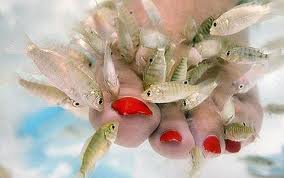
A new fad is the fish pedicure. You feet are placed in a tank with skin eating carp. They gently clean the dead skin off your feet. This is not allowed in certained areas of the country because of the concern of spreading diseases. The fish can spread diseases such as Hepatitis and HIV, especially in patients that are immunocompromised.
The best advice is to use your own clean instruments. Use a vitmain enriched antifungal nail polish to add some color to you toes. Nail polishes, such as Dr. Remedy TM which comes in a variety of colors, uses tea tree oil as a natural antifunal component to prevent fungus nails. Simple care of your feet including using a pumice stone and an urea based cream to help soften calluses or hard skin after a shower or bath can prevent the need for pedicures. They are just not worth the risks.
Dr. "Sandie" Grulke
http://www.podiatrycarespecialists.com/
Tuesday, April 17, 2012
Treatments for Nail Fungus
With the weather getting warmer and summer approaching, we kick off our boots and shoes for warm weather footwear. The flip flops, sandals and bare feet are making a comeback. BUT don't let fungal toenails stop you from enjoying the approaching summer weather. Fungal toenails, also known as onychomycosis, is a fungal infection under the nail and in the nail bed. The fungus lives in everyone's shoes likes the dark moist environment. Simple dropping something on your foot or the nail lifting up because they are too long, can allow the nail fungus to get under the nail and infect it. Unforntunately, it is easy to get and difficult to get rid of. Despite this, there are several different treatment options available.
The oral medication which is the most effective can have liver side effects. The liver must be tested prior to usage of the oral medications and during treatment. The oral medications include Giseofulving, Lamisil and Sporanox. For this reason, the oral medication is not always the first line of treatment.
The topical medications can be effective and safe alternatives to the oral medications. However, just any antifungal cream will not work because it has to be able to penetrate throught the nail plate in order to destroy the nail fungus.
One active ingredient to look for in a topical treatment is Tolnaftate, an antifungal drug. It has been placed in an oil based solution which allows the medication to penetrate through the nail unlike other over the counter preparations which are either water or alcohol based.
![]() |
| Tea Tree |
Other ingredients in treating onychomycosis are tea tree oil, Vick's VapoRub TM and vinegar. Tea Tree Oil is a natural antifungal agent that in the right formulation can rid the fungal infection. Camphor is the main ingredient of Vick's VapoRub TM. There are three major fungal species responsible for causing fungal infections and camphor has been shown to be effective in one of these three infections. Vingear, also known as acetic acid, changes the pH of the toenail and can kill the fungus under the nail. It is reported to have good nail penetration but be careful with this ingredient as it is an acid and can be corrosive.
Laser treatments are also being used for nail fungus. Certain laser companies have been FDA approved for short term resolution of nail fungus. Unfortunately, most insurance companies are not covering this procedure and it be costly.
As with all treatments, the treatment for nail fungus can take many months. Be patient. These treatments can be effective but they can take 6-12 months of treatment. Also for successful treatment treat your shoes with an antifungal spray to reduce the amount of fungus to prevent reinfection.
Dr. "Sandie" Grulke
http://www.podiatrycarespecialists.com/
Monday, March 5, 2012
Ingrown Toe Nails in West Chester, PA?
http://www.podiatrycarespecialists.com/
Subscribe to:
Posts (Atom)